
Small to midsize freight forwarders lose thousands annually to manual data entry errors and operational inefficiencies. CargoWise One tackles this head-on, with users reporting up to 75% reduction in data entry errors when using its automation features. This comprehensive guide explains how CargoWise One works, why it's transforming operations for SMB freight forwarders, and how to implement it successfully in 2026.
Table of Contents
- Understanding CargoWise One: The Backbone Of Modern Freight Forwarding
- How CargoWise One Reduces Data Entry Errors And Operational Inefficiencies
- Comparing CargoWise One With Other Transport Management Systems
- Integration Capabilities: Connecting CargoWise One With Data Automation Tools
- Best Practices And Common Challenges When Implementing CargoWise One
- Common Misconceptions About CargoWise One
- Real-World Impact: Case Studies And User Outcomes
- Discover How QuoteParser Integrates With CargoWise One To Save You Time
- What Is CargoWise One Used For In Freight Forwarding?
- Is CargoWise One Suitable For Small And Midsize Freight Forwarding Companies?
- How Does CargoWise One Integrate With Other Data Automation Tools?
- What Are Common Challenges When Implementing CargoWise One?
Key takeaways
| Point | Details |
|---|---|
| Unified platform | CargoWise One integrates core freight forwarding functions into a single, global platform. |
| Error reduction | Automation reduces data entry errors by up to 75%, improving operational accuracy. |
| Scalable pricing | Modular design and pricing make it accessible and affordable for SMB freight forwarders. |
| Proven results | Real-world users report up to 35% throughput improvement and 20% labor cost savings. |
| Integration ready | Seamless connections with tools like QuoteParser cut manual data entry hours significantly. |
Understanding CargoWise One: The backbone of modern freight forwarding
CargoWise One serves as a comprehensive transport management system designed specifically for freight forwarders managing complex, multi-country shipment operations. It centralizes functions that traditionally required multiple disconnected software tools, creating a single source of truth for your entire operation.
The platform supports operations in over 110 countries globally, making it particularly valuable for freight forwarders handling international shipments. This global reach means you can manage customs compliance, documentation, and regulatory requirements across different jurisdictions without switching between systems.
CargoWise One provides several core capabilities that form the operational backbone:
- End-to-end visibility across the complete shipment lifecycle, from quote to delivery
- Real-time data access enabling faster decision making and proactive customer communication
- Automated customs processing and compliance documentation reducing manual workload
- Modular architecture allowing SMBs to implement only the features they need
- Integrated accounting and financial management tied directly to shipment data
The modular design proves especially valuable for smaller freight forwarders. You're not forced to adopt every feature on day one. Instead, you can start with core shipment management and gradually add capabilities like warehouse management or advanced analytics as your operation grows.
Real-time data access transforms how you operate. When a shipment status changes, your team, customers, and partners see updates instantly. This transparency reduces phone calls, emails, and the constant status checking that eats up productive hours.
How CargoWise One reduces data entry errors and operational inefficiencies
Manual data entry creates a cascade of problems for freight forwarders. A single typo in a container number can delay shipments, trigger compliance issues, and erode profit margins through what the industry calls "margin leakage."
CargoWise One attacks this problem through centralized data management. When you enter shipment information once, it flows automatically to invoices, customs documents, tracking systems, and customer portals. This eliminates the repeated manual entry that causes most errors.

The platform's document management automation proves particularly powerful. CargoWise One can extract data from emails, PDFs, and other documents, then route information to the correct fields automatically. Users report up to 75% reduction in data entry errors when these automation features handle routine tasks.
Key efficiency improvements include:
- Automated rate calculation pulling from your negotiated carrier contracts
- Digital workflow routing that replaces manual handoffs between team members
- Exception alerts highlighting issues before they become costly problems
- Standardized processes ensuring consistent handling across all shipments
Pro Tip: Start by automating your highest-volume, most repetitive processes first. Most freight forwarders see the fastest ROI by automating quote entry and basic shipment creation before tackling more complex workflows.
The reduction in margin leakage delivers immediate financial benefits. When pricing errors decrease and you capture all accessorial charges correctly, profit margins improve without increasing revenue. For a midsize freight forwarder processing 500 shipments monthly, eliminating just 2% of pricing errors can recover thousands in monthly revenue.
Comparing CargoWise One with other transport management systems
The TMS market offers several alternatives, each with distinct strengths and limitations. Understanding how CargoWise One compares helps you make an informed decision for your operation.
| Feature | CargoWise One | Magaya | Descartes | FreightPath |
|---|---|---|---|---|
| Global customs automation | Comprehensive | Moderate | Strong | Limited |
| Modular pricing | Yes | No | Limited | Yes |
| Real-time visibility | Excellent | Good | Excellent | Moderate |
| SMB-focused design | Strong | Strong | Enterprise focus | Strong |
| Implementation complexity | Moderate | Low | High | Low |
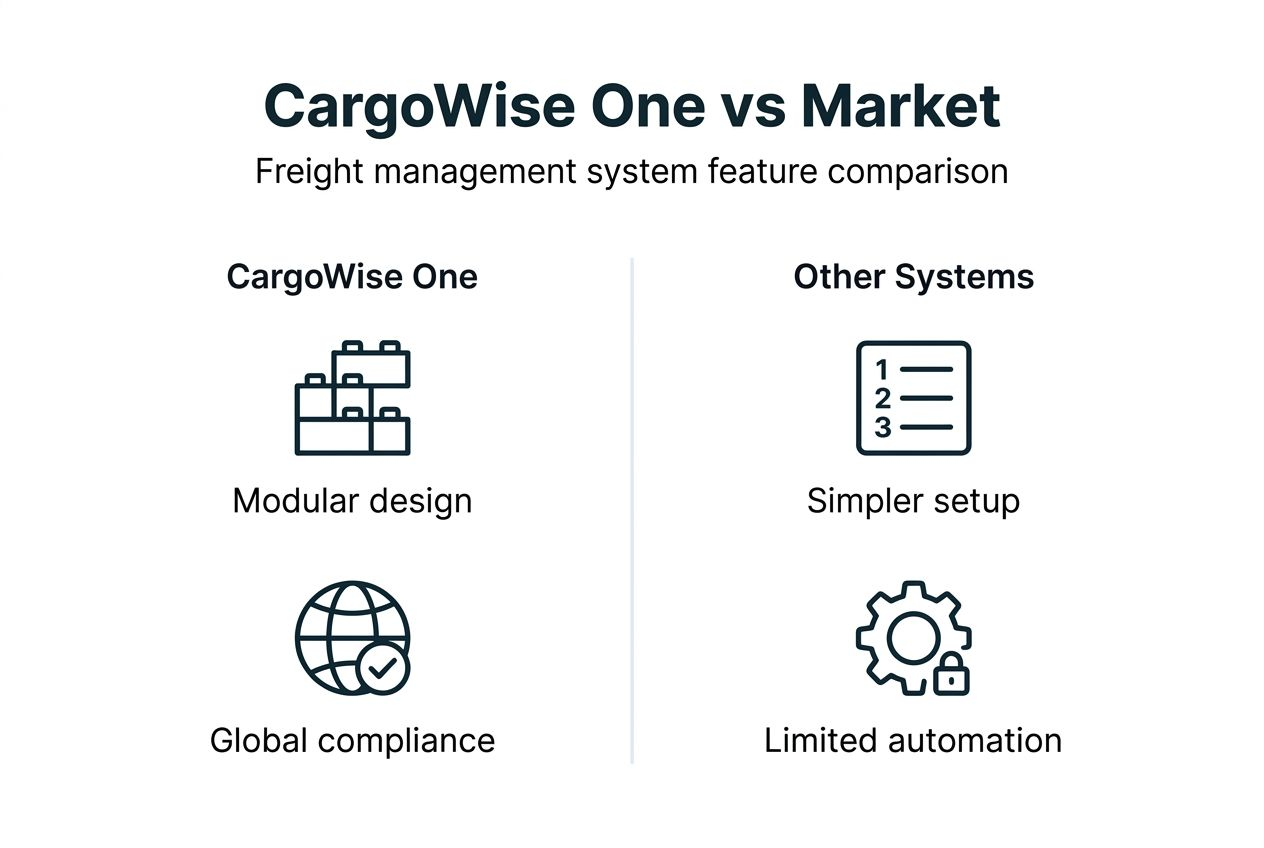
CargoWise One distinguishes itself through superior global customs compliance and supply chain visibility compared to most competitors. If your freight forwarding operation handles significant international volume with complex customs requirements, this advantage becomes critical.
The modular architecture provides genuine value for SMBs:
- Lower upfront investment through phased implementation
- Pay only for modules you actively use
- Easier to justify ROI when starting small
- Natural growth path as your operation expands
Magaya offers simpler initial setup but lacks the sophisticated global compliance features that become essential as you scale. Descartes provides powerful capabilities but typically targets larger enterprises with corresponding price points and complexity.
CargoWise One strikes a middle ground. It handles the complexity of international freight forwarding without overwhelming smaller teams. The learning curve exists, but comprehensive training resources and a large user community provide support.
Integration capabilities: Connecting CargoWise One with data automation tools
CargoWise One's real power emerges when you connect it with specialized automation tools that handle specific pain points. The platform provides robust APIs enabling real-time data synchronization with third-party applications.
Integration with QuoteParser API integration exemplifies this capability. Instead of manually typing carrier quotes from Maersk, MSC, or other ocean carriers into CargoWise One, QuoteParser extracts the data from PDF quotes and formats it for direct import. This reduces manual re-entry by 15-20 hours weekly per user.
| Integration Type | Benefit | Typical Time Savings |
|---|---|---|
| Quote automation | Eliminates PDF data entry | 15-20 hours/week |
| Rate management | Auto-updates carrier rates | 8-12 hours/week |
| Tracking integration | Real-time status updates | 5-8 hours/week |
| Accounting sync | Automatic invoice generation | 10-15 hours/week |
The API architecture supports both inbound and outbound data flows. You can pull shipment data from CargoWise One to populate customer portals, business intelligence tools, or accounting systems. Simultaneously, external applications can push data into CargoWise One, creating seamless information flow.
Pro Tip: Map your most time-consuming manual processes before exploring integrations. The 80/20 rule applies here - typically 20% of your processes consume 80% of manual entry time. Target those first for automation.
Native integrations cover common industry tools including customs platforms, warehouse management systems, and financial software. This ecosystem approach means you're not locked into a single vendor's solution for every function.
Best practices and common challenges when implementing CargoWise One
Successful CargoWise One implementation requires methodical planning and realistic expectations. Freight forwarders who rush implementation or skip critical steps often face extended timelines and frustrated teams.
-
Assess your current workflows comprehensively. Document how your team currently handles quotes, bookings, documentation, and invoicing. Identify specific pain points where errors occur or processes bottleneck.
-
Select modules matching your immediate needs. Don't attempt to implement every available feature. Most successful SMB implementations start with core shipment management and basic accounting integration.
-
Plan a phased rollout to minimize disruption. Typical implementation timelines range from 3 to 9 months depending on scope. Breaking this into phases keeps your operation running while you transition.
-
Invest heavily in staff training. The most common implementation failure stems from inadequate training. Your team needs hands-on practice with realistic scenarios, not just overview presentations.
-
Establish clear success metrics before launch. Define what "working" means for your implementation. Track data entry time, error rates, and processing speed to demonstrate ROI.
-
Build a support structure for the transition period. Designate internal champions who receive extra training and can help teammates troubleshoot issues during the first months.
-
Test thoroughly with real data before going live. Use actual shipments from your operation to validate that configurations handle your specific requirements correctly.
The most common challenge involves underestimating the change management aspect. Your team has established habits and workflows. Even when CargoWise One offers clear improvements, people naturally resist changing familiar processes. Address this through early involvement, transparent communication about benefits, and patience during the learning period.
Common misconceptions about CargoWise One
Several persistent myths about CargoWise One prevent freight forwarders from seriously evaluating the platform. Understanding the reality behind these misconceptions helps you make decisions based on facts rather than assumptions.
Myth: Only large enterprises can afford CargoWise One. Reality: Modular pricing models make it accessible for SMBs. You're not paying for enterprise-scale features you don't need. Small freight forwarders successfully run operations on CargoWise One by implementing only core modules initially.
Myth: Implementation always takes over a year and disrupts operations. Reality: Phased, well-planned deployments typically complete within three to nine months. The key is realistic scoping and not trying to transform everything simultaneously.
Myth: You need a large IT team to maintain CargoWise One. Reality: Cloud-hosted versions eliminate most infrastructure management. Your team needs process knowledge more than technical expertise. Many SMB freight forwarders operate successfully with no dedicated IT staff.
Key misconceptions about complexity:
- The platform is only for international freight forwarders handling complex customs
- You must migrate all historical data before using CargoWise One
- Training requires months of full-time dedication for each user
- The system is too rigid to accommodate your unique processes
These misconceptions often stem from outdated information or hearing about implementations that lacked proper planning. Modern CargoWise One implementations, particularly for SMBs, follow streamlined approaches that address these concerns directly.
Real-world impact: Case studies and user outcomes
The theoretical benefits of any TMS matter less than actual results from freight forwarders like you. CargoWise One users consistently report measurable improvements across key operational metrics.
Users report 35% improvement in operational throughput and 20% reduction in labor costs following successful implementation. These gains come from multiple sources working together:
- Automated data entry eliminating repetitive typing
- Reduced error correction time from improved accuracy
- Faster quote turnaround through automated rate retrieval
- Decreased customer service calls due to self-service portals
- Streamlined documentation reducing shipment processing time
A midsize freight forwarder in California handling 400 monthly shipments documented specific improvements after their six-month implementation. They reduced quote response time from 4 hours to 45 minutes, decreased billing errors by 68%, and cut overtime hours by roughly 25%.
Margin leakage reduction delivers particularly impressive financial returns. When you correctly capture all charges, apply the right rates, and eliminate pricing errors, profit margins improve immediately. One Texas-based forwarder recovered approximately $3,200 monthly in previously lost revenue simply by reducing accessorial charge errors.
Shipment visibility improvements accelerate decision making throughout your operation. When problems surface immediately rather than days later, you can resolve issues before they escalate. This proactive approach improves customer satisfaction and reduces emergency firefighting that disrupts your team's productivity.
User feedback consistently highlights scalability benefits. As these freight forwarders grew their shipment volumes, CargoWise One scaled naturally without requiring additional staff proportional to growth. This operational leverage creates sustainable competitive advantages.
Discover how QuoteParser integrates with CargoWise One to save you time
You've learned how CargoWise One transforms freight forwarding operations through automation and centralized data management. Now consider how QuoteParser quote automation amplifies these benefits by eliminating one of the most time-consuming manual tasks: processing carrier quotes.
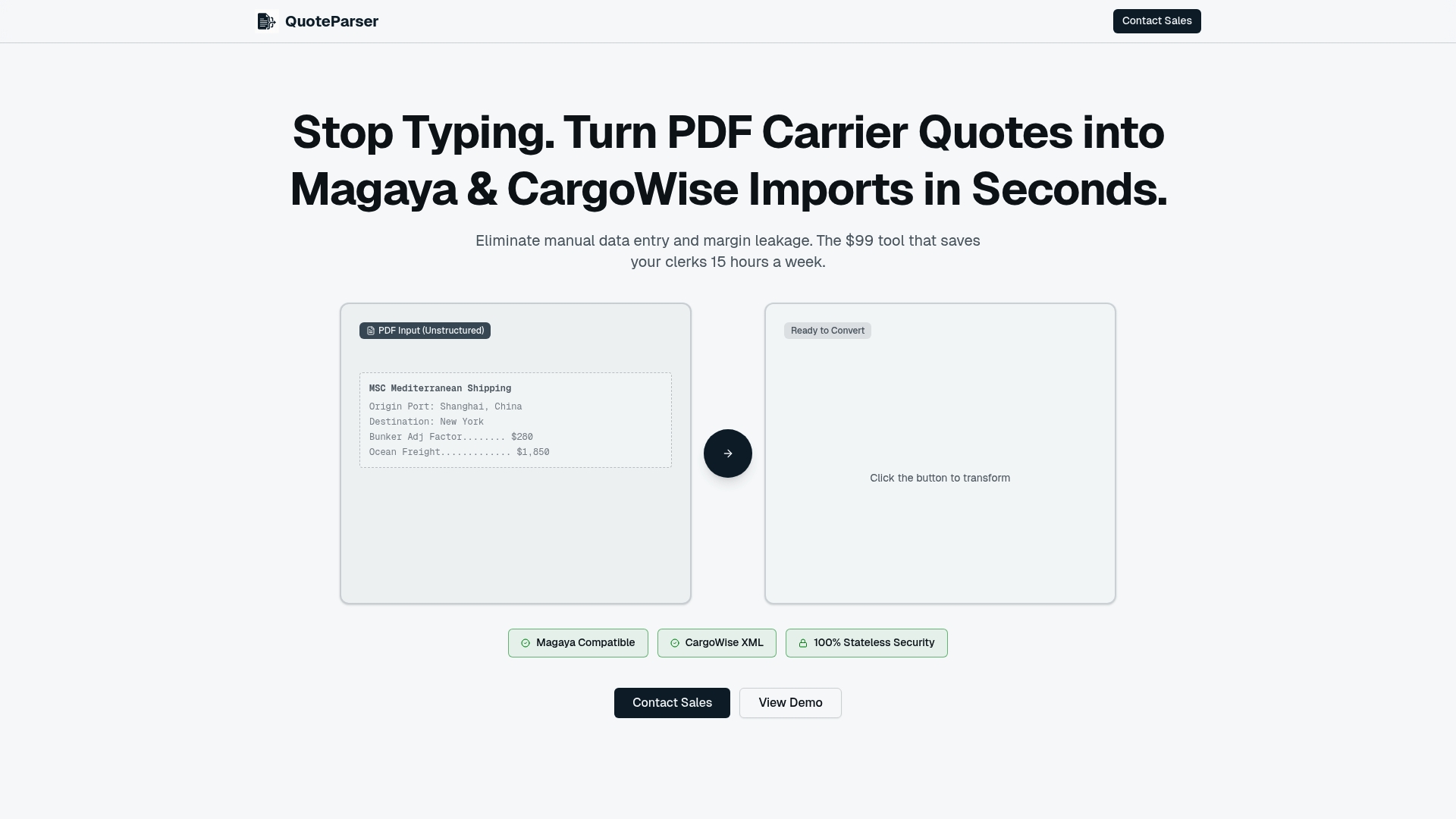
QuoteParser converts PDF carrier quotes from ocean carriers into CargoWise One-ready imports instantly. Instead of spending 15 to 20 hours weekly typing rate information, your team simply uploads quotes and imports formatted data directly. The API integration ensures accurate, real-time synchronization between QuoteParser and your CargoWise One system.
For SMB freight forwarders looking to cut operational costs while improving accuracy, QuoteParser delivers immediate ROI. You maximize your CargoWise One investment by automating the data entry that still consumes significant manual effort.
What is CargoWise One used for in freight forwarding?
CargoWise One streamlines freight forwarding workflows by centralizing operations in one platform. It handles shipment booking, documentation, customs compliance, tracking, invoicing, and accounting in a unified system. This eliminates the need to maintain multiple disconnected software tools.
The platform automates data entry, reduces errors, and provides real-time visibility across your entire operation. Freight forwarders use it to manage ocean, air, and ground transportation while handling the complex documentation requirements of international shipping.
Designed to scale with SMB freight forwarders, CargoWise One improves accuracy and throughput without requiring proportional staff increases. It supports growth by handling higher volumes through automation rather than additional manual labor.
Is CargoWise One suitable for small and midsize freight forwarding companies?
Yes, CargoWise One's modular design and pricing make it accessible and scalable for small and midsize freight forwarders. You implement only the modules you need initially, avoiding enterprise-scale costs for unused features. The phased adoption approach allows you to match implementation complexity to your current business size and operational requirements.
How does CargoWise One integrate with other data automation tools?
CargoWise One offers native API integrations with tools such as QuoteParser integration that automate PDF quote data extraction. These integrations reduce manual re-entry by 15-20 hours weekly per user. The API architecture supports real-time bidirectional data flow, allowing external applications to both push data into and pull data from CargoWise One seamlessly.
What are common challenges when implementing CargoWise One?
Common challenges include underestimating training needs and attempting to implement all modules simultaneously. Successful implementations use phased rollouts that introduce features gradually, allowing teams to adapt. Comprehensive staff training is essential - most implementation difficulties stem from inadequate preparation rather than technical issues with the platform itself.